Keywords
• Talent management
• Intern conversion
• Career satisfaction
• Organizational attractiveness
• Internship
• Talent retention
• Intern conversion
• Career satisfaction
• Organizational attractiveness
• Internship
• Talent retention
Download Article
Statistics
• Read: 946
• Download: 625
Submitted:
Nov 29, 2024
Accepted:
Dec 11, 2024
Published:
Dec 24, 2024
Citations
Table of Contents
Abstract
This study examines the effect of perceived intensity of talent management practices on the intention of interns to convert to full-time employees. Based on signaling theory and social exchange theory, the research explores the mediating roles of career satisfaction and organizational attractiveness in this relationship. Data were collected from 103 interns, with a nearly equal gender distribution, through an online survey. The study employs multiple regression and mediation analyses to test the proposed hypotheses. The findings reveal that higher perceived intensity of talent management practices is positively associated with both career satisfaction and organizational attractiveness, which in turn significantly influence interns' conversion intentions. More specifically, organizational attractiveness fully mediates the relationship between talent management practices and conversion intentions, while career satisfaction serves as a partial mediator. These results emphasize the importance of implementing effective talent management practices during internships to enhance interns’ career satisfaction and the attractiveness of the host organization, ultimately increasing the likelihood of retaining interns as full-time employees. The study contributes to the understanding of how strategic management of internships can serve as a pathway to talent acquisition and retention.
How to Cite
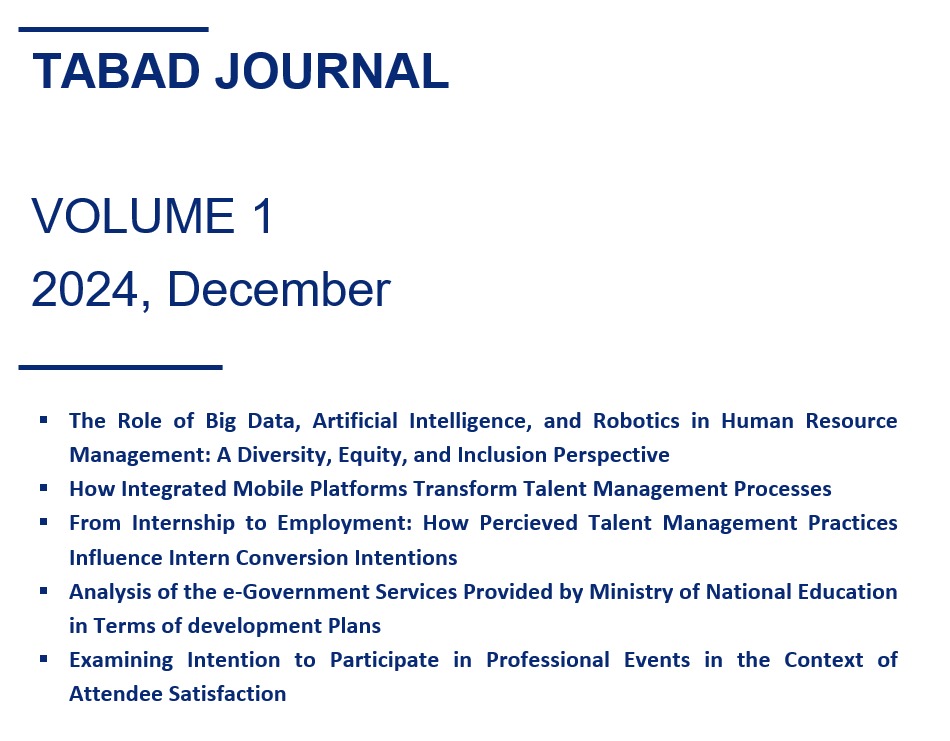
Tekbıyık, M. (2024). From Internship to Employment: How Perceived Talent Management Practices Influence Intern Conversion Intentions. TABAD Journal, 1(1), 33-61. https://tabadjournal.org/ojs/index.php/tbd/article/view/12
Full Article
Open Access License

This work is licensed under a Creative Commons Attribution-NonCommercial-ShareAlike 4.0 International License, which permits unrestricted non-commercial used, distribution and reproduction in any medium.
References
1. Aburumman, O., Salleh, A., Omar, K., & Abadi, M. (2020). The impact of human resource management practices and career satisfaction on employee’s turnover intention. Management Science Letters, 10(3), 641-652.
2. American Psychological Association. (2018). APA dictionary of psychology. https://dictionary.apa.org/talent
3. Anlesinya, A., Dartey-Baah, K., & Amponsah-Tawiah, K. (2019). A review of empirical research on global talent management. FIIB Business Review, 8(2), 147-160.
4. Association for Talent Development (ATD). (2024). Talent development glossary terms: What is talent management? https://www.td.org/talent-development-glossary-terms/what-is-talent-anagement#:~:text=A%20talent%20management%20strategy%20defines,functions%20should%20not%20operate%20independently
5. Beenen, G., & Rousseau, D. M. (2010). Getting the most from MBA internships: Promoting intern learning and job acceptance. Human Resource Management: Published in Cooperation with the School of Business Administration, The University of Michigan and in alliance with the Society of Human Resources Management, 49(1), 3-22.
6. Berthon, P., Ewing, M., & Hah, L. L. (2005). Captivating company: dimensions of attractiveness in employer branding. International journal of advertising, 24(2), 151-172.
7. Bethke-Langenegger, P., Mahler, P., & Staffelbach, B. (2011). Effectiveness of talent management strategies. European Journal of International Management, 5(5), 524-539.
8. Björkman, I., Ehrnrooth, M., Mäkelä, K., Smale, A., & Sumelius, J. (2013). Talent or not? Employee reactions to talent identification. Human Resource Management, 52(2), 195-214.
9. Blau, P. M. (1964). Justice in social exchange. Sociological inquiry, 34(2).
10. Bonneton, D., Schworm, S. K., Festing, M., & Muratbekova-Touron, M. (2022). Do global talent management programs help to retain talent? A career-related framework. The International Journal of Human Resource Management, 33(2), 203-238.
11. CIPD (2018) Talent Management: An overview, Factsheet. London: CIPD.
12. CIPD (2023) Talent Management: An overview, Factsheet. London: CIPD.
13. https://www.cipd.org/uk/knowledge/factsheets/talent-factsheet/
14. CIPD (2023) Employer brand: An overview, Factsheet. London: CIPD.
15. https://www.cipd.org/uk/knowledge/factsheets/recruitment-brand-factsheet/
16. Coetzee, M., & Stoltz, E. (2015). Employees' satisfaction with retention factors: Exploring the role of career adaptability. Journal of Vocational Behavior, 89, 83-91.
17. Collings, D. G., & Mellahi, K. (2009). Strategic talent management: A review and research agenda. Human resource management review, 19(4), 304-313.
18. Connelly, B. L., Certo, S. T., Ireland, R. D., & Reutzel, C. R. (2011). Signaling theory: A review and assessment. Journal of management, 37(1), 39-67.
19. Cook, S. J., Stokes, A., & Parker, R. S. (2015). A 20-year examination of the perceptions of business school interns: A longitudinal case study. Journal of Education for Business, 90(2), 103-110.
20. D'abate, C. P., Youndt, M. A., & Wenzel, K. E. (2009). Making the most of an internship: An empirical study of internship satisfaction. Academy of management learning & education, 8(4), 527-539.
21. Dassler, A., Khapova, S. N., Lysova, E. I., & Korotov, K. (2022). Employer attractiveness from an employee perspective: A systematic literature review. Frontiers in Psychology, 13, 858217.
22. De Boeck, G., Meyers, M. C., & Dries, N. (2018). Employee reactions to talent management: Assumptions versus evidence. Journal of Organizational Behavior, 39(2), 199-213.
23. Dries, N., & Pepermans, R. (2007). “Real” high‐potential careers: An empirical study into the perspectives of organisations and high potentials. Personnel Review, 37(1), 85-108.
24. Edwards, M. R. (2017). Employer branding and talent management. The oxford handbook of talent management, 233-248.
25. European Commission. (2010, June 24-25). Working group “Food Safety Statistics" meeting: Updated methodological information - Typology of sampling strategies (Chair: Mrs. A. Clemenceau, Item 4.4.b. of the agenda). Luxembourg.
26. Ewerlin, D. (2013). The influence of global talent management on employer attractiveness: An experimental study. German Journal of Human Resource Management, 27(3), 279-304.
27. Farley, C. (2005). HR's role in talent management and driving business results. Employment Relations Today, 32(1), 55-61.
28. Feild, H. S., & Harris, S. G. (1991). Entry-Level, Fast-Track Management Development Programs: Developmental Tactics and Perceived Program Effectiveness. Human Resource Planning, 14(4).
29. Festing, M., & Schäfer, L. (2014). Generational challenges to talent management: A framework for talent retention based on the psychological-contract perspective. Journal of World Business, 49(2), 262-271.
30. Gallardo-Gallardo, E. (2018). The meaning of talent in the world of work. Global talent management, 33-58.
31. Gallardo-Gallardo, E., Dries, N., & González-Cruz, T. F. (2013). What is the meaning of ‘talent’in the world of work?. Human Resource Management Review, 23(4), 290-300.
32. Gallardo-Gallardo, E., & Thunnissen, M. (2016). Standing on the shoulders of giants? A critical review of empirical talent management research. Employee Relations, 38(1), 31-56.
33. Greenhaus, J. H., Parasuraman, S., & Wormley, W. M. (1990). Effects of race on organizational experiences, job performance evaluations, and career outcomes. Academy of management Journal, 33(1), 64-86.
34. Hergert, M. (2009). Student Perceptions of The Value Of Internships In Business Education. American Journal of Business Education, 2(8), 9-14.
35. Highhouse, S., Lievens, F., & Sinar, E. F. (2003). Measuring attraction organizations. Educational and psychological Measurement, 63(6), 986-1001.
36. Hofmans, J., Dries, N., & Pepermans, R. (2008). The Career Satisfaction Scale: Response bias among men and women. Journal of vocational behavior, 73(3), 397-403.
37. Hongal, P., & Kinange, U. (2020). A study on talent management and its impact on organization performance-an empirical review. International Journal of Engineering and Management Research, 10.
38. Hora, M. T., Lee, C., Chen, Z., & Hernandez, A. (2021). Exploring Online Internships amidst the COVID-19 Pandemic in 2020-2021: Results from a Multi-Site Case Study. WCER Working Paper No. 2021-5. Wisconsin Center for Education Research.
39. Hurst, J. L., Gardner, P., & Dorie, A. (2023). Are Unpaid Internships Just as Valuable? A Comparison of US Work Integrated Learning Students' Perceptions of Paid and Unpaid Experiences. International Journal of Work-Integrated Learning, 24(1), 57-81.
40. Hurst, J. L., Good, L. K., & Gardner, P. (2012). Conversion intentions of interns: what are the motivating factors?. Education+ Training, 54(6), 504-522.
41. Igartua, J. J., & Hayes, A. F. (2021). Mediation, moderation, and conditional process analysis: Concepts, computations, and some common confusions. The Spanish journal of psychology, 24, e49.
42. Jiang, T., & Iles, P. (2011). Employer‐brand equity, organizational attractiveness and talent management in the Zhejiang private sector, China. Journal of Technology Management in China, 6(1), 97-110.
43. Kaothan, O. (2018). Organizational attractiveness and person job fit as the predictors of intention to stay of employees commercial bank. Journal of Administrative and Business Studies, 4(3), 156-164.
44. King, K. A. (2015). Global talent management: Introducing a strategic framework and multiple-actors model. Journal of Global Mobility, 3(3), 273-288.
45. Lee, C. S., & Chao, C. W. (2013). Intention to “leave” or “stay”–the role of internship organization in the improvement of hospitality students’ industry employment intentions. Asia Pacific Journal of Tourism Research, 18(7), 749-765.
46. Lee, C., Liu, J., Rousseau, D. M., Hui, C., & Chen, Z. X. (2011). Inducements, contributions, and fulfillment in new employee psychological contracts. Human Resource Management, 50(2), 201-226.
47. Lewis, R. E., & Heckman, R. J. (2006). Talent management: A critical review. Human resource management review, 16(2), 139-154.
48. Lievens, F., Van Hoye, G., & Anseel, F. (2007). Organizational identity and employer image: Towards a unifying framework. British journal of management, 18, S45-S59.
49. McDonnell, A., Skuza, A., Jooss, S., & Scullion, H. (2023). Tensions in talent identification: a multi-stakeholder perspective. The International Journal of Human Resource Management, 34(6), 1132-1156.
50. Meyers, M. C., van Woerkom, M., Paauwe, J., & Dries, N. (2020). HR managers’ talent philosophies: prevalence and relationships with perceived talent management practices. The International Journal of Human Resource Management, 31(4), 562-588.
51. Michaels, E., Handfield-Jones, H., & Axelrod, B. (2001). The war for talent. Harvard Business Press.
52. Minbaeva, D., & Collings, D. G. (2013). Seven myths of global talent management. The International Journal of Human Resource Management, 24(9), 1762-1776.
53. Mitchell, T. (2023). The Perceived Benefits, Limitations, and Effects of Virtual Internships on Obtaining Employment for Undergraduates in Business and Information Technology.
54. Nae, E. Y., & Choi, B. K. (2022). Career satisfaction, subjective well-being and turnover intention: an attachment style perspective. Baltic Journal of Management, 17(1), 1-17.
55. National Association of Colleges and Employers. (2022). Quick poll on spring recruiting and career services. https://www.naceweb.org/talent-acquisition/trends-and-predictions/winter-2022-quick-poll-on-spring-recruiting-and-career-services
56. National Association of Colleges and Employers (NACE). (2023). Best Practices for Internship Programs. https://www.naceweb.org/talent-acquisition/internships/15-best-practices-for-internship-programs/
57. National Association of Colleges and Employers. (2024). Internship meaning and definition: A NACE guide. https://www.naceweb.org/internships
58. Pandita, D., & Ray, S. (2018). Talent management and employee engagement–a meta-analysis of their impact on talent retention. Industrial and Commercial Training, 50(4), 185-199.
59. Parker, C., Scott, S., & Geddes, A. (2019). Snowball sampling. SAGE research methods foundations.
60. Pingle, S. S., & Sodhi, H. K. (2011). What makes an attractive employer: significant factors from employee perspective?. Anvesha, 4(2), 18.
61. P. Maertz Jr, C., A. Stoeberl, P., & Marks, J. (2014). Building successful internships: lessons from the research for interns, schools, and employers. Career Development International, 19(1), 123-142.
62. Rogers, S. E., Miller, C. D., Flinchbaugh, C., Giddarie, M., & Barker, B. (2021). All internships are not created equal: Job design, satisfaction, and vocational development in paid and unpaid internships. Human Resource Management Review, 31(1), 100723.
63. Rose, P. S., Teo, S. T., & Connell, J. (2014). Converting interns into regular employees: The role of intern–supervisor exchange. Journal of Vocational Behavior, 84(2), 153-163.
64. Rynes, S. L., Bretz Jr, R. D., & Gerhart, B. (1991). The importance of recruitment in job choice: A different way of looking. Personnel psychology, 44(3), 487-521.
65. Salleh, A. M. M., Omar, K., Aburumman, O. J., Mat, N. H. N., & Almhairat, M. A. (2020). The impact of career planning and career satisfaction on employee's turnover intention. Entrepreneurship and Sustainability Issues, 8(1), 218.
66. Saltikoff, N. (2017). The positive implications of internships on early career outcomes. National Association of Colleges and Employers. https://ebiztest.naceweb.org/job-market/internships/the-positive-implications-of-internships-on-early-career-outcomes/
67. Sandeepanie, M. H. R., Gamage, P., Perera, G. D. N., & Sajeewani, T. L. (2023). The role of talent management and employee psychological contract on employer branding: a pragmatic conceptual model. Management Research Review, 46(2), 196-222.
68. Scullion, H., & Collings, D. G. (2011). Global talent management: Introduction. In Global talent management (pp. 19-32). Routledge.
69. Sharma, R., & Prasad, A. (2018). Employer brand and its unexplored impact on intent to join. International Journal of Organizational Analysis, 26(3), 536-566.
70. Spence, M. (1973). Job Market Signaling. The Quarterly Journal of Economics, 87(3), 355-374.
71. Spencer, E. A., Brassey, J., & Mahtani, K. (2017). Recall bias. Catalogue of bias.
72. Stahl, G. K., Björkman, I., Farndale, E., Morris, S. S., Paauwe, J., Stiles, P., ... & Wright, P. M. (2007). Global talent management: How leading multinationals build and sustain their talent pipeline (Vol. 34). Fontainebleau: Insead.
73. Stahl, G., Björkman, I., Farndale, E., Morris, S. S., Paauwe, J., Stiles, P., ... & Wright, P. (2012). Six principles of effective global talent management. Sloan Management Review, 53(2), 25-42.
74. Stewart, A., Owens, R. J., Hewitt, A., & Nikoloudakis, I. (2018). The regulation of internships a comparative study (No. 994987592002676). International Labour Organization.
75. Tarique, I., & Schuler, R. S. (2010). Global talent management: Literature review, integrative framework, and suggestions for further research. Journal of world business, 45(2), 122-133.
76. Taylor, M. S. (1988). Effects of college internships on individual participants. Journal of applied Psychology, 73(3), 393.
77. Tsai, W. C., & Yang, I. W. F. (2010). Does image matter to different job applicants? The influences of corporate image and applicant individual differences on organizational attractiveness. International Journal of Selection and Assessment, 18(1), 48-63.
78. Turban, D. B., & Cable, D. M. (2003). Firm reputation and applicant pool characteristics. Journal of Organizational Behavior: The International Journal of Industrial, Occupational and Organizational Psychology and Behavior, 24(6), 733-751.
79. Tymon Jr, W. G., Stumpf, S. A., & Doh, J. P. (2010). Exploring talent management in India: The neglected role of intrinsic rewards. Journal of World Business, 45(2), 109-121.
80. Ulrich, D., & Smallwood, N. (2012). What is talent?. Leader to leader, 2012(63), 55-61.
81. Wayne, J. H., & Casper, W. J. (2012). Why does firm reputation in human resource policies influence college students? The mechanisms underlying job pursuit intentions. Human Resource Management, 51(1), 121-142.
82. Wiblen, S., & McDonnell, A. (2020). Connecting ‘talent’meanings and multi-level context: A discursive approach. The International Journal of Human Resource Management, 31(4), 474-510.
83. Wong, M. M. L., Lau, K. H., & Chan, C. W. F. (2021). The impacts and success factors of a work-from-home service-learning internship during COVID-19. Journal of Work-Applied Management, 13(2), 284-301.
84. Yaqub, B., & Khan, M. A. (2011). The role of employer branding and talent management for organizational attractiveness. Far East Journal of Psychology and Business, 5(5), 57-65.
85. Zhao, H., & Liden, R. C. (2011). Internship: A recruitment and selection perspective. Journal of Applied Psychology, 96(1), 221.
86. Zopiatis, A., Theocharous, A. L., & Constanti, P. (2018). Career satisfaction and future intentions in the hospitality industry: An intrinsic or an extrinsic proposition?. Journal of Human Resources in Hospitality & Tourism, 17(1), 98-120.